Wednesday, February 12, 2020

On to Nevada


Senator Amy Klobuchar in Concord, NH on election night
Former Vice President Joe Biden skipped town before the polls closed in New Hampshire, but Minnesota Senator Amy Klobuchar stayed around to bask in her surprising Third place finish.  Senator Elizabeth Warren and Biden, two of the early Democratic front runners, finished distant fourth and fifth, respectively.  Biden's 8.4 percent share of the Democratic vote was even surpassed on the Republican side by former Massachusetts Governor Bill Weld's 9.1 percent.  For those of you keeping score, President Donald Trump got 85.5 percent of the GOP vote, compared to former President Ronald Reagan's 86 percent in 1984.

The race now moves to the Nevada caucuses on February 22nd and the South Carolina primary on February 29th.  Biden is banking on a strong showing in Nevada, followed by a win in South Carolina, but the strength of former South Bend, Indiana Mayor Pete Buttigieg and Klobuchar may put a big dent in the Bidenmobile.  Buttigieg, Klobuchar, and Biden appeal to a similar demographic on the political spectrum (they're the perceived moderates, whereas Senator Bernie Sanders and Warren are the liberals.)  Since Warren has had some wind taken out of her sails in both Iowa and New Hampshire, Sanders may be in a stronger position in this fickle, momentum-driven primary process.

What's Next

New Hampshire has winnowed the Democratic field.  Businessman Andrew Yang, Colorado Senator Michael Bennett, and former Massachusetts Governor Deval Patrick have all "suspended" (dropped out) their campaigns.  On the Republican side, former Congressman Joe Walsh dropped out before New Hampshire, but Weld will continue his long-shot effort.

Biden has a 3.5 percent lead in the Realclearpolitics.com average over Sanders, but there has been no serious polling done in Nevada in over a month.  Back when the last polls were taken, in early January, Biden was leading in almost all national polls and the public had not seen his poor finishes in Iowa and New Hampshire.  There has also been an apparent drop in Biden's African American support, a key constituency for Biden, and a group that can make up to 60 percent of South Carolina Democratic primary voters.

Stay tuned for a special onevotecounts campaign diary with a heck of a lot of photos.

Tuesday, February 11, 2020

As Goes Dixville Notch, so Goes the Nation


Dixville Notch polling place
Dixville Notch, New Hampshire may have the first say in the nation in Presidential politics, but it is certainly not the last.  The tiny hamlet in Northern New Hampshire, just a few miles from the Canadian border cast their ballots in the Presidential election and former New York Mayor Mike Bloomberg won on both sides. 

After failing to secure a single vote in Dixville Notch, President Donald Trump immediately tweeted that the residents of Dixville Notch are "stupid" and should "good back to Canada."  Just kidding.

Dixville Notch

Dixville Notch first jumped into the national spotlight with its midnight voting in the 1960 Presidential election, when then-Vice President Richard Nixon shut out Senator John Kennedy nine to zip.  Since then, the residents of Dixville Notch continue to vote in the Presidential primary and general elections at the stroke of midnight.  They vote, the polls are closed, they count the votes, and then they announce about 10 minutes after midnight.  As always, the voters are greatly outnumbered by members of the media.

The voting takes place on the grounds of The Balsams, a beautiful 11,000-acre mountain resort originally built-in 1875.  Until this year, the voting took place in the main building of the resort, which has been shuttered since new owners took over in 2011.  The new owners have been trying to obtain financing to renovate and expand the resort's ski area.  As of last night, none of the expansion or renovation has begun, and it was a very eerie feeling driving up to and passing the shuttered resort.  Civilization re-appeared when we saw lights, about fifty cars parked alongside the road, and the satellite news trucks.

Bloomberg wins

Bloomberg garnered the only vote on the Republican side and two of the four votes on the Democratic side.  Senator Bernie Sanders and Mayor Pete Buttigieg both captured a single vote.  The Bloomberg votes were write-ins, because Bloomberg entered the race too late to qualify for the New Hampshire primary. (There were 33 candidates on the Democratic side and 17 on the Republican side.)

Bloomberg has pretty much ignored New Hampshire, unlike the multitude of candidates who hve been holding events throughout the state for more than a year.  Bloomberg has, however, spent over $200 million on television advertising, primarily in Super Tuesday states.  (Super Tuesday is the Super Bowl of primary days, where more than one-third of the Democratic delegates are up for grabs in states like Texas, Virginia, California, and Massachusetts.  Super Tuesday is March 3rd this year.)

The results of Dixville Notch are not always are a good predictor of who will win the nomination, and if you don't believe us, just ask President Wesley Clark (he won in 2004) and President John Kasich (he won in 2016,) but the votes and the interviews afterward are telling.  The fact that Bloomberg won both sides as a "write-in" candidate shows at least some dissatisfaction with the major candidates on the Democratic side and President Trump.  We know it's a very small statistical sample, but the fact that Bloomberg is on the minds of the voters in this small hamlet in extreme Northern New Hampshire shows that the millions of dollars that Bloomberg is pouring into advertising is having an effect.

Stay tuned.  We're off to see Andrew Yang.


Monday, February 10, 2020

On the ground in New Hampshire


Hopefully, the rain won't hurt the rhubarb or Mayor Pete Buttigieg's impending New Hampshire primary victory.  Buzz and I decided to do what any good reporting duo would do when inclement weather hits, we hit Castro's Backroom in downtown Manchester, New Hampshire for a cigar.  (We're not Jim Cantore and this ain't the Weather Channel.)  And by the way, for our conservative readers, despite the Castro name, we didn't find Bernie Sanders here.

Mayor Pete's momentum has seemed to slow in the daily tracking polls, but Buzz's calculations on the Univac 3000 still predict a Mayor Pete victory. Although the more intriguing stories are the rise of Minnesota Senator Amy Klobuchar and the fall of Massachusetts Senator Elizabeth Warren and former Vice President Joe Biden.  Klobuchar is looking to finish a strong third, while Biden and Warren are looking at fourth and fifth place.  Biden is looking to salvage his campaign with a respectable showing in the Nevada caucuses (February 22nd)  and a win in the South Carolina primary (February 29th,) but New Hampshire may be the end of the road for Warren.

For a brief shining moment a few months back, Warren was looking good, but she seems to be a victim of 21st Century politics.  She is one of the best candidates on "paper," but, for better or worse, we are living in a sound bite era.  All the position papers and well-formulated policies aren't hitting home with the current voters who are more influenced by their hearts than their minds. 

Buzz has crunched the numbers, and here's his bold prediction of the order of finish in the Granite State.  Buttigieg, Sanders, Biden, Warren, Klobuchar, Yang, Gabbard, and Steyer. 

We're going to hit the streets and look for some buzz. 

On the Republican side, President Donald Trump supporters have been lining up outside the arena for Trump's rally since early this morning.  Although there are 17 candidates on the Republican ballot, Buzz has predicted that Trump will see upwards of 94 percent of the Republican vote.  Former Massachusetts governor WilliamWeld will finish a distant second.  Buzz has calculated his finish at 1.7 percent of the vote.

We're going to brave the weather and hit the streets.  God willing and the creek don't rise, we'll end our day in Dixville Notch.  The votes will be in shortly after midnight from this little hamlet near the Canadian border.  All five voters cast their ballots and the votes will be counted by 12:10 AM.

Stay tuned.

Sunday, February 9, 2020

We're off to New Hampshire


Mayor Pete is the guy to beat.  Even though the results of the 2020 Iowa caucuses are still a bit muddled, there are two things we learned from Iowa that are certain --- Former Vice President Joe Biden is in trouble and Pete Buttigieg came away with the big MO.

Buzz has fueled up the VW Microbus and we're off to New Hampshire to see for ourselves.  This is the third New Hampshire Presidential Primary for Buzz and me, and it may be the most exciting yet.  We look to a recent poll of likely New Hampshire Democratic voters that found 62 % would rather see a giant meteor hit the Earth and wipe out human existence than see President Donald Trump re-elected on November 3rd as proof of the enthusiasm.

Recent polls in New Hampshire have shown Mayor Pete on the rise and Biden dropping like the face of the Old Man of the Mountain.  The Boston Globe/Suffolk University daily tracking poll has seen Mayor Pete rise from eight percent to 22 percent in the past week.  The same poll showed Biden drop from 24 percent to 10.  Other polls show similar trends. 

Senator Bernie Sanders, who won the 2016 Democratic primary in New Hampshire over Hillary Clinton by 22 points seems to have a ceiling and a floor in not only New Hampshire but across the country, especially with multiple candidates in the race.  Mayor Pete has risen in the numbers apparently by grabbing former Biden supporters.  Sanders's support has remained pretty steady over the last few months in New Hampshire.

Both primaries (the Republican and Democratic) are contested, with 33 candidates on the Democratic side and 17 on the Republican side.  Most of these candidates will only get a handful of votes statewide, and most of them are and will remain political unknowns.  The requirements to get on the New Hampshire Presidential Primary ballot is to file a "declaration of candidacy" and pay a $1000 fee.  Unfortunately, our good friend Vermin Supreme will grace neither the Republican or Democratic ballot this year.  He's running in 2020 as a Libertarian.  We hope to see him in New Hampshire.

Watch for entries as our trip begins.  See you in the Granite State.

Friday, May 31, 2019

Nothing to see here


Should we believe President Donald Trump or our own lying eyes?  Plain and simple, Congress needs to start an impeachment inquiry into the country's chief executive.  Trump was not "completely exonerated" of obstruction of justice.  The road map to impeachment is in the Mueller report and, despite what Attorney General William Barr says, Special Counsel Robert Mueller intended Congress to take up the process from here, because he believed his office could not indict a sitting President no matter how compelling the evidence.

Mueller concluded his investigation, closed the Special Counsel's office, and rode off into the sunset, but not before telling the country that the torch has been passed on to Congress. (Listen to Mueller's full statement here.)

High Crimes and Misdemeanors

Like many concepts and terms in the United States Constitution, the phrase "high crimes and misdemeanors" is not defined.  The United States Constitution is a relatively brief document when it comes to constitutions, and that was the way the framers intended it to be.  The wisdom of the framers was that times would change and so would our understanding of the Constitution.  Anyone who believes that the Founding Fathers intended us to be stuck in time and to the absolute four corners of the United States Constitution does not understand the history of the early Republic.

The phrase "high crimes and misdemeanors" generally means any serious matter that violates the "public trust."  Alexander Hamilton wrote in Federalist 65, that impeachment "offenses which proceed from the misconduct of public men, or, in other words, from the abuse or violation of some public trust."

Article I of the President Richard Nixon articles of impeachment charged that Nixon "prevented, obstructed, and impeded the administration of justice..."  All the Articles of impeachment never came to fruition, because Nixon saw the writing on the wall (Republican Senators Hugh Scott and Barry Goldwater telling him he didn't have the votes to stop a conviction) got the hell outta Dodge and resigned.  Scott, the Senate minority leader told Nixon that he had, at most, 15 Senators that would vote for acquittal (34 were needed to save the Nixon Presidency.)

Findings of the Mueller investigation that support impeachment

Nixon directed the Central Intelligence Agency to force the Federal Bureau of Investigation to shut down its probe into the Watergate burglary, he directed subordinates to pay hush money payments to subjects of the investigation, then he fired Special Prosecutor Archibald Cox.  All of these actions provided the basis for Article I of the Nixon impeachment.

Trump repeatedly tried to get then-Attorney General Jeff Sessions not to recuse himself from the Mueller investigation so Sessions could shut it down, he fired James Comey as FBI Director in order to attempt to stop Comey's investigations into Russian influence on the 2016 election, he ordered White House counsel Don McGahn to fire Mueller, and he urged Paul Manafort, Michael Flynn, and Michael Cohen to "stay strong" and they would be rewarded (a Presidential pardon down the road.)  If this isn't obstruction of justice, the term obstruction has no meaning.

“Because we determined not to make a traditional prosecutorial judgment, we did not draw ultimate conclusions about the President’s conduct,” the Mueller report said. “The evidence we obtained about the President’s actions and intent presents difficult issues that would need to be resolved if we were making a traditional prosecutorial judgment. At the same time, if we had confidence after a thorough investigation of the facts that the President clearly did not commit obstruction of justice, we would so state.”

Thursday, April 25, 2019

It depends on what the meaning of is is


Former President Bill Clinton famously said "it depends on what the meaning of 'is' is.  Republicans were appalled by Clinton's lawyer-speak, after all, words have meanings and to play games with words are not what the "strict constructionists" believe.

Strict Constructionism

Republicans are big fans of strict constructionism.  They say time and time again that Judges should not "make law," but should interpret the law as it was written.  Look to the statute and don't pull a Bill Clinton "is is." Strict constructionists look at the literal meaning of the words in question, or at their historical meaning at the time the law was written. Congress' demand to see President Donald Trump's taxes are grounded in an unambiguous statute which empowers them to do so.

Trump's taxes

The House Ways and Means Committee has requested the Department of Treasury (the IRS) to turn over six years of Trump's.  Trump has said he is not obligated to turn over his taxes and is directing the IRS to not turn them over.  Trump believes that the Democrats are acting "politically" and therefore Trump is not obligated to turn over his taxes.  Apparently, the President who appoints strict constructionists the federal bench doesn't believe in strict construction when it pertains to him.

Tax information is generally between the IRS and the individual.  There are a few exceptions to this general rule.  States, for example, can access your federal tax information if they deem it necessary to reconcile the information you sent your state versus what you sent the Feds,  Congress (the Ways and Means Committee in particular) has the power under a 1924 law to get tax returns and related tax information on any American if they ask for it.  This is an absolute rule.  Congress need not state a reason.

The 1924 law states, "Any committee (such as the Ways and Means Committee) shall have the authority ... to inspect returns and return information at such time and in such manner as may be determined by such chairman..."  This provision applies to anyone who files taxes, and the origins of this law had its impetus in scandals under the President Warren Harding administration.  Congress did not have the power to get tax returns prior to the 1924 law, so Congress granted themselves the power.

Why we need to see the tax returns

Congress needs to see Trump's tax returns for one simple reason --- we need to know if his business interests conflict with the interests of the American people.  If we don't know the exact extent of Trump's financial interests, we cannot know for sure whether Trump is acting in the best interests of the American people or in his own best financial interests.  Trump either does not understand this or doesn't care.  In either case, that's conduct inconsistent with the job of leader of the free world.

We do have precedent and a perfect example of what full disclosure looks like.  In 1974, President Gerald Ford (himself appointed to the job of Vice President) appointed a man whose name is synonymous with wealth --- Nelson Rockefeller. 

Rockefeller was Governor of New York for 15 years and a man who sought the Presidency in his own right a number of times.  Rockefeller was also extremely wealthy, with business interests all over the world.  When he was nominated by Ford, Congress had serious concerns that Rockefeller's job could be affected by his vast business interests.

Did Rockefeller give Congress the middle finger?  No, that was a couple years later and not directed at Congress.  Rockefeller engaged in a procedure foreign to Trump.  It's called "full disclosure." Rockefeller submitted himself to months of Congressional inquiry.  He was nominated by Ford on August 20, 1974, and was not finally approved by the Senate until almost four months later on December 10, 1974,

We need to know the exact extent of Trump's financial interests, and the fact that he won the 2016 Presidential election does not mean this issue has been already litigated.  The Republican Congress woefully neglected their oversight duties in 2017 and 2018 by not asking for the financial information. 

Checks and Balances

Congress is a co-equal branch of government, and in fact, it can be argued that the Founding Fathers actually believed that Congress was more important than the other two branches.  Congress' powers and duties are addressed in Article One, the President in Article Two, and the Judiciary in Article Three.  The Founding Fathers were afraid of any branch having too much power.  Each branch was directed to "keep an eye" on the other. 

As outlined in the Federalist Papers (No. 51), James Madison explained that "the biggest threats to the government of the United States would be the ability of one governing branch to obtain too much power over another..." 


Tuesday, April 2, 2019

Get Over It, Obamacare Is Here To Stay


In 2010, the GOP kicked some electoral butt as a result of Obamacare, now they're about to get their butts kicked if they keep up efforts to appeal it.  The Affordable Care Act (Obamacare) is here to stay, and it is and always was the signature accomplishment of the Obama administration. To quote Joe Biden, it's a "big F**KING deal."

How does it work?

The Affordable Care Act is officially known as the Patient Protection and Affordable Care Act, but has become known as the "Obamacare."  Obamacare was the classic "law by committee." President Barack Obama took a hands-off approach to the crafting of the law and allowed Congressional Committees to craft differing versions of a law whose main goal was to cover as many Americans as possible.  The result which is by no means perfect was light years ahead of the messed up system that was in place.

Despite attempts for a single payer system or even a system with a "public option," the overall plan is still primarily a private insurance company based system.  Most Americans (excluding those over 65, disabled, or covered under the Children's Health Insurance Program {CHIP}) have some form of employer-based healthcare.  Obamacare made it mandatory for employers with over 50 fulltime employees (30 hours or more a week) to offer "affordable" and "minimum essential coverage." The rest of the public (excluding the aforementioned seniors and the disabled) fell under mandated Obamacare insurance.

Without getting into the specifics of federally run exchanges and state-run exchanges, Obamacare gave monetary subsidies to individuals making between 100 and 400 percent of the federal poverty level (around $12,000 a year per individual and an additional $4000 for each dependent.)  The Advanced Premium Tax Credits amounted to large "gifts" to the health insurance companies which allowed individuals to pay reduced premiums for health insurance.  The subsidies allowed millions of people the chance at health coverage.  This was the "carrot."  The "stick" was the individual mandate (a monetary penalty if you didn't buy health insurance.)

If your income is under 133 percent of the poverty level (about $16,000  a year for an individual or $32,000 for a family of four) you are eligible for Medicaid (the Medicaid Expansion.)  If you make over $48,000 as an individual or $96,000 for a family of four, you do not get any financial help buying insurance, but you still have to purchase health insurance or face a financial penalty assessed by the IRS on your next year's taxes.

All of this, by the way, is paid and did not increase the deficit.

The Supreme Court mucks it up

As soon as Obamacare became the "law of the land," Republicans (the guys and gals who abhor the courts "making" laws) filed legal challenges to strike down Obamacare.  The thrust of their argument was that the mandate to buy insurance was an unconstitutional use of power by the federal government.  It was argued that the Commerce Clause did not allow Congress to force people to buy health insurance, which, of course, lead to the crazy legal discussions by the late Justice Antonin Scalia about the federal government forcing individuals to buy broccoli.

In the end, Chief Justice John Roberts saved the day, by declaring Obamacare good to go constitutionally, but not under the Commerce Clause, but he reasoned that the individual mandate was a "tax" and Congress certainly has the right to tax.  He also threw a bone to the conservatives by saying that states were not required to enact the Medicaid expansion, because that was a bridge too far constitutionally.  A number of states (those controlled by Democratic legislatures or Governors,) took the federal money and expanded Medicaid.  Those under Republican control said "we don't want your stinkin' money" and shafted its poorest residents by refusing to expand Medicaid.  The number of states expanding Medicaid has steadily increased, and currently 37 states and the District of Columbia have expanded Medicaid (the most recent few by popular referendum.)


The Supreme Court may get another chance to muck things up if the case which is working its way through the federal court system makes its way to Washington. Before the GOP got its butt handed to them in the 2018 election, Republicans repealed the individual mandate as part of their tax "reform" legislation.  This afforded those diehard Obamacare haters to file suit which basically says that since there is no more individual mandate, there is no tax, and thus the whole of Obamacare is unconstitutional.  A federal judge in Texas agreed, but his ruling is on hold pending appeal.

Repeal and Replace

Repeal and Replace has been the mantra of Republicans for years when it comes to Obamacare.  While this slogan carried some weight when the GOP first coined the phrase, it no longer excites crowds, except for true believers.  This lack of favor came for two major reasons --- Republicans had no "replacement" and Obamacare now usually polls at least fifteen points on the positive side.  It seems like people are happy with the law's prohibition of discriminating against people with pre-existing conditions, keeping children on their plans until age 26, the subsidies, and the elimination of junk insurance plans.  The jury is also in on premium costs because even though health insurance costs continue to rise, the rate of increase has slowed dramatically.

The basic reason for passing Obamacare was to increase the number of individuals with health coverage.  Health insurance would no longer be a luxury only for those who could pay the bill.  Hard working individuals would now be able to go to get medical care without having to "tough it out" and pray for the best or get medical care and then seek bankruptcy protection.  At least 20 million people now have health insurance who wouldn't without Obamacare, and the GOP and President Donald Trump have no plan to cover these people.  Health Savings Accounts ain't gonna do it.

Where do we go from here?

Obamacare is here to stay, and thankfully so.  Millions of Americans now have health insurance who could never afford it.  One of the groups who benefit the most from Obamacare are those "small business people" the GOP loves to canonize.  It is not uncommon for a family health insurance plan to cost as much as $3000 a month, that $36,000 a year for those of you scoring at home.

A small businessman (making $60,000 a year) with a family of four would have to pay about $2000 a month for a family health insurance plan.  Under Obamacare, that small businessman would now get that same coverage for about $400 a month.  Now he can make that business grow and not have about being forced into bankruptcy by health insurance premiums or bills from an unexpected illness.

President Trump has promised a "really good" health insurance plan both on the campaign trail and now since he's instructed the Justice Department to join GOP Attorneys General in support of striking down Obamacare.  He recently said, the GOP will become the "party of healthcare."  This ain't gonna happen if you don't have a plan.  Trump's die-hard bases might take him on his word about healthcare, but a good majority of the American people won't.

Buzz and I are in agreement with a vast majority of the American people.  Fix Obamacare and don't throw the baby out with the bath water. Obamacare is not perfect, but it is so, so much better than what we had before.  Millions of more Americans are covered, and that's a great start.  Let's start tweaking it to cover even more Americans.

Wednesday, March 27, 2019

The Fat Lady Hasn't Sung Just Yet


Despite President Donald Trump's victory dance on Attorney General William Barr's four-page summary of the Mueller report, the Fat Lady has not begun to sing on Trump's legal problems. 

Investigating a Murder and finding a Bank Roberry

Prosecutors cannot turn a blind eye to one crime when they are investigating another. Trump's victory lap is certainly premature.  This is not because the "deep state" is relentless or because the "fake news" media is out to get him,  it is because, despite the fact that Mueller failed to find evidence of criminal collusion, he conducted an investigation which resulted in numerous indictments, including the conviction of former Trump campaign chairman Paul Manafort.

In addition to Manafort, Trump's former "fixer" and former lawyer (Michael Cohen) is counting the days until he goes to federal prison on charges that included paying a porn star (Stormy Daniels) for her silence in violation of campaign finance law.  Trump, by the way, was named as an unindicted co-conspirator in that case. 

Russia, Russia, Russia

We also found out that Trump lied repeatedly about his business dealings with Russia.  Trump repeatedly said on the campaign trail and well into his Presidency he had no business dealings with Russia, or that they ended prior to 2016.  Such is certainly not the case.

Trump's business interest in Russia (or at that time, the Soviet Union) began in the mid 1980s when he explored the possibility of building hotels in Russia, including one "across the street from the Kremlin."  He bragged about this in his book "Art of the Deal."   His interest in Russia as a business opportunity never came to fruition, but it also didn't end until well into 2016 when he was saying he didn't have and wasn't pursuing any business deals in Russia.

The best defense Buzz and I heard with regards to the collusion with Russia is that the Trump campaign was so disorganized that it couldn't collude with anyone, including itself.  We believe this, wholeheartedly. 

Where do we go from here?

As we said, this is not over, and rightfully so.  The Democratic Congress will continue to do its job --- provide the checks and balances spelled out in the United States Constitution.  They are investigating and will continue to investigate Trump, despite the summary of the findings of the Mueller investigation. 

In addition to the previously mentioned election finance law violation, Trump's inaugural committee is being investigated for possible illegal spending and fundraising, his charitable organization has been fined millions of dollars and forced to close its doors, and there are multiple issues being investigated by Congress and various United States Attorney's offices in Trump's past business dealings.  These investigations will, in all likelihood continue to haunt Trump for years to come.

Just because Trump squeaked out a Presidential election victory in the perfect storm of 2016 doesn't mean that we should turn a blind eye to prior wrongdoings.  He is not above the law since he has been elected President.  If Trump did not want increased scrutiny, he never should have ridden down the escalator in 2015 and announced his candidacy for President of the United States.  The Presidency has many perks, but being scrutinized on everything you do and ever did is not one of them.  It is a hazard of the job.

When it comes to investigations, we quote the late Yogi Berra, "it ain't over 'til it's over," and the "fat lady" hasn't even warmed up.

Thursday, March 7, 2019

Uncle Joe is gonna run


Donald Trump's worst electoral nightmare is coming to a state near you. Buzz has been crunching data with the Univac 3000, and the results are in:  Joe Biden will run for President in 2020.  Biden needs to win the Democratic nomination first, but the blue-collar, "ordinary Joe" is just the type of candidate who has the best chance of putting Pennsylvania, Michigan, and Wisconsin back in the Democratic column and sending Trump back to New York City and his "friends" at the Southern District of New York's prosecutors' office.

2016 Election was not a landslide but any stretch of the imagination

The 2016 election of Donald Trump was the perfect storm that cracked the vaunted Democratic Blue Electoral wall.  Let's look at the numbers first.

Trump did not win the popular vote, in fact, he lost it by almost three million votes, 62,980,160 to 65,845,063.  With regards to the electoral vote, he narrowly won that --- 304 to 227.  (There was an unusually large number of faithless electors --- those who vote for a candidate other than the one who won their respective states.  Colin Powell got three, and John Kasich, Ron Paul, Bernie Sanders, and Faith Spotted Owl each received one vote.)  For those of you scoring at home, you need 270 to win.  Without the faithless electors, Trump still wins 306 to 238.

The election came down to Trump's narrow victories in three of the blue wall states --- Pennsylvania, Michigan, and Wisconsin.  Those 46 electoral votes went to Trump, but without them, he loses 278 to 260.  The popular vote victories in those states were Pennsylvania (44,292), Wisconsin (22,748, and Michigan (10,704), for a total of 77,744.  The victories in these three states were powered by first-time or first-time in a long time voters who overwhelmingly voted either for Trump or against Hillary Clinton.

Changing demographics put Arizona (11 electoral votes), Georgia (16), and Texas (36) into play for the Democrats in 2020, so Trump will no only have to hold the three rust belt states he won in 2016 but will have to play defense in these three soon-to-be Purple states.

Why Joe's gonna run

Joe Biden would be President now if he ran against Trump in 2016.  He did not enter the race, primarily because of the tragic death of his son 46-year-old son Beau in 2015 from brain cancer.  It's a decision that we believe he regrets greatly. 

Biden ran for President twice before (1988 and 2008), but both times did poorly.  The difference this time started when he got the call from candidate Barack Obama in 2008 to be Obama's running mate.  This changed everything.  He was instantly transformed from an also-ran to a somebody.  His tenure as the "stand-by-your-man" Vice President only enhanced his stature.  He has been involved in politics for over 50 years, having been elected to the Senate from Delaware at just prior to his 30th birthday in 1972.  The political bug is in his blood and it will never leave him until the day he dies.

Being the political animal he is, Biden certainly sees the poll numbers.  Biden either leads or is at the top of every Democratic Presidential preference poll and leads Trump in every electoral state that is going to make the difference in 2020.  Yes, a lot of this has to do with name recognition, but Biden is not only well known, but he is very well liked, despite his propensity to make a major gaffe now and then.  Actually, his gaffe-making adds to his genuineness.

Biden also polls very well with the blue-collar workers (the Reagan Democrats) who got up off their couches and cast a vote for Trump in the crucial states.  Hillary never made a connection with these voters in 2016.  They were never enthused enough and Trump seemed like someone who felt their plight.  Biden has the same effect on these voters, albeit not as strong as Trump did in 2016, but enough to make the difference in 2020.

For these major factors, Biden will run, and why not --- he loves the political arena, and for the first time in his political career (2016 doesn't count,) he actually has a pretty clear path to the White House.  As far as the age issue, Trump will be 74 on election day 2020 and Biden turns 78 17 days after election day 2020.  Biden is in good health, and besides, they say that 70 is the new 50, so Biden is only 56 years old right now.

So Biden's options are to sit on the sidelines and rue the 2016 decision not to run or follow the political animal blood in his veins and jump back into the political arena with much more than a Don Quixote chance at becoming President.  The Univac 3000 says he's in and so do Buzz and I.

Tuesday, March 5, 2019

The New Normal


Impeach first, ask questions later.  If Barack Obama were still the President, the Republicans would be trying to ride him outta town on a rail if he tried to get away with a scintilla of the crap Donald Trump did.  A major part of the problem is a substantial sector of the American populace doesn't believe Trump did anything wrong.

When we look to the veracity of the two men the difference is stark.  According to the New York Times, Trump told six times as many lies in the first ten months of his administration as Obama did in his complete eight years at the helm.  Yes, we are not that naive to think that politicians don't stretch the truth, but as a good friend of mine says, "don't piss on me and tell me it's raining," and that's exactly what Trump is doing to the American people.

Truth is an absolute

The latest tally from the Washington Post has President Donald Trump at 9014 false or misleading claims over the first 773 days of his administration.  In Saturday's speech at the Conservative Political Action Committee annual gathering in Washington, D.C. he told 200 misleading or false claims in a two-hour speech.  Despite this, thirty-five to forty percent of the population is unmoved.  The objective truth that Trump is lying is chalked up to "fake news."

The late Senator Daniel Patrick Moynihan was fond of saying, "everyone is entitled to their own opinion, but not their own facts."  Apparently, in Trump's America, Trump and his supporters are entitled to their own set of facts.  It is much easier to make an argument when you start with the argument and then move to the facts than to use objective facts and tailor your argument to those facts. By contrast, it is impossible to have a constructive argument or discussion if you can't agree on the facts.

Let's turn to baseball for a quick analogy.  Here are a couple of quick, objective, and easily verifiable facts.  Outfielder Barry Bonds hit 762 home runs over the span of his 22-year baseball career and Shortstop Ozzie Smith hit 28 home runs over the span of his 19-year career.  Once we agree on the number of home runs each player hit and the positions they played, it would be foolish to argue that Smith was a better home run hitter or that Bonds was a better shortstop, however, if you believe that Smith hit 800 home runs and Bonds won 18 gold gloves at shortstop, we could argue all day long on the aforementioned propositions.

When did we lose our way

Since the solidification of the two-party system in the United States (probably the election of 1860,) the two major parties have had their disagreements on a wide array of issues.  Their positions have changed on some issues and their basis of support has changed over the years, but since the founding of the Republic, we have been a nation which knows how to compromise when it comes to getting things done.  Our Constitution is rooted in some major compromises, such as the creation of two houses of Congress, the apportionment of House seats, the separation of powers which all came about through negotiation and compromise.

This idea of compromise helped us make our way through the past 200 plus years.  We have addressed issues and come to solutions by taking two divergent points of view and forging something which wasn't always the solution that either side originally envisioned.  This was possible because parties generally agreed on the facts or at least the major facts.  Today, it seems like the problem is not coming to a compromise agreement, it is agreeing on the facts to start working to that solution.

Republicans and Democrats have almost always disagreed on how to solve a particular problem, but in most cases, they were able to distinguish fact from fiction.  They also realized that most people involved in the political process were in it because they love this country and truly want to do what they see is best for their constituents.  A lot of this changed in 1994 when Newt Gingrich grabbed hold of the soul of the Republican party, and this change was exacerbated in 2010 when the Tea Party movement began.  The final descent into the rabbit hole was the election of Donald Trump in 2016.

We need to get back on track

The only way that we will forge ahead in this great nation of ours is if we start agreeing on the facts.  We need to realize that even our political enemies may have a point now and then, and believe it or not, those same people love America just as much as you do.  Buzz and I were not big fans of George W. Bush, but we never doubted his patriotism.  And, Bush's biggest mistake was not made because he made up facts and flat out lied to us, but because he believed faulty intelligence.  20/20 hindsight is a great thing, and we can now look back at the Iraq war disaster and realize it was based on bad intelligence.

In Trump's America, the truth is not objective.  It's whatever Trump says it is.  Did Russia try to influence the 2016 Presidential election?  Nope.  The intelligence agencies say yes, but Trump says no because Vladimir Putin said Russia didn't.  Was Kim Jong Un responsible and aware of the torture of Otto Warmbier?  Experts say yes, but Trump says no because Kim Jong Un says he didn't.

We cannot continue like this. We need to accept that certain things are verifiable truths.  This is serious stuff that affects the American people.  This is not Trump padding his wealth to jump up a few spots on Forbes' list of the wealthiest people or continually using superlative adjectives that categorizes everything he does as "the biggest, the largest, the best, or the most."  We expect politicians to paint things in the most positive light, but we don't expect or deserve them to continually lie about things that any rational person sees as outright false.

Monday, February 25, 2019

The one word that explains Trump 2016 victory: Hillary


Two plus years later, Buzz and I have come to a definitive conclusion.  Donald Trump won the Presidency for one reason and one reason only --- Hillary Clinton.  Bernie Sanders or even Martin O'Malley, Lincoln Chafee, or Tim Webb (yeah the three other Democratic candidates) would be touting the title of the 45th President of the United States.

The Vast Right-Wing Conspiracy

It took some time to realize exactly how bad of a candidate Hillary actually was.  It doesn't have anything to do with Benghazi or the missing emails.  They were made-up BS scandals that were disregarded by a vast majority of American voters, and remember, Hillary did beat Trump by over three million votes.  What it really came down to was what Hillary talked about 25 years ago --- the "vast right-wing conspiracy."  (Well maybe not vast, but persistent as all hell.)

For years and years, the GOP has been railing against Hillary Clinton.  The fact that she is not the warm and fuzzy candidate like her husband Bill made it easier for the attacks to stick.  Even good liberals had serious trouble warming up to her (hence the Feel the Bern.)  (And for those of you who believe Bernie got burned by the Democratic National Committee (DNC,) remember this, Hillary still kicked his butt in the popular primary vote and all those rules which favored Hillary had been in place for years --- they weren't changed mid-stream by Debbie Wasserman-Schultz or any other nefarious DNC figure.)

Don't get us wrong, we believe Hillary would have been a very good President, certainly much better than Trump could ever be, but even Buzz and I never really warmed to her.  She would have been an overly-hard worker who wouldn't continually embarrass the office home and abroad.  She also would not have prided herself in ignorance to all things Presidential.

Michigan, Wisconsin, and Pennsylvania

Trump won in 2016 because the Founding Fathers set up this crazy thing called the Electoral College, a system which gives a disproportionate advantage to smaller states.  (Electoral votes are based on Congressional representation (one vote for each member of the House and one for each Senator.)  That's kind of fair for the House numbers, but totally undemocratic for the Senate number.  The state of Wyoming gets one electoral vote for 300,000 people on the Senate side, whereas California gets one electoral vote for 20,000,000 million people.  In other words, all things being equal, the California equivalent would be about 67 Senate based electoral votes.

Because of the Electoral College set up, Trump was able to win the Presidency by getting pluralities in three states --- Michigan, Pennsylvania, and Wisconsin.  The margin in these three states was 77,744 votes.  Trump's victory was the perfect storm of Electoral politics.  The big question is, can he repeat the perfect storm in 2020, that is if he survives until then.  Short of impeachment, Trump will win the Republican primary without any significant opposition.  A good majority of Republican voters have retreated to such a fact-free bubble that Trump could "shoot someone on 5th Avenue" and get away with it.  Their bubble is so impenetrable that only alternative facts get in.

It was highly unlikely that Trump could have pulled Electoral College magic out of his hat in 2016, but 2020 is even more unlikely.  He also has to worry about losing states like Arizona, and maybe even Texas this time around.  2018 saw major statewide wins for Democrats in 2018 in Michigan, Pennsylvania, and Wisconsin.  Pennsylvania saw its incumbent Democratic Governor win by 17 points and its incumbent Democratic Senator win by 13 points.  Michigan had a Democratic defeat a GOPer in an open seat for Governor by 10 points and incumbent Democratic Senator win by seven points.  Wisconsin saw its two-term incumbent GOP Governor lose by one point and its incumbent Democratic Senator win by 11 points.

2020 Presidential Race

The Presidential Primary season begins in about 11 months, and there are already enough Democratic candidates to field an NFL team, with a least a few more guaranteed to enter the fray.  Trump will get some opposition, but as for the reasons mentioned above, unless he's impeached, he will be the Republican nominee in 2020.  He has insulated himself so well that even in the Robert Mueller report says Trump should be indicted, only an impeachment vote by the Senate (and that would require 20 GOP Senators to join the Democrats to vote for impeachment) would derail Trump's re-election.

The other problem Trump faces in 2020 is that fact that the voters who fueled his narrow 2016 victory were either first-time voters or voters who had not voted in any recent Presidential elections.  Sure some of them will vote again, but at least half of this usually apathetic group of voters will not venture to the polls again in high enough numbers to fuel another Trump electoral win.

So as long as Hillary does not win the Democratic nomination, Trump will not be in the White House come the afternoon of January 20, 2021, and to paraphrase Gerald Ford, "our long national nightmare will be over."

Wednesday, September 6, 2017

My grandmother, the "dreamer"


It was the late Spring of 1892 and my paternal grandmother celebrated her first birthday on a ship crossing the icy waters of the North Atlantic. Her parents left their native Poland to seek a new life in America.  My grandmother was a "dreamer."

One hundred and twenty-five years later, President Donald Trump has told "dreamers" that they are no longer welcome in the land of the free and the home of the brave.  (Dreamers are individuals in the U.S. who were brought to the country at an early age without documentation but have assimilated to U.S. culture and have been educated by U.S. school systems.)

DACA

President Barack Obama created Deferred Action for Childhood Arrivals (DACA) in June of 2012 after Congress failed to act,  but President Trump has decided to end DACA, ..... maybe.   DACA provided for administrative relief from deportation. It protects eligible immigrant youths who came to the United States when they were children from deportation. DACA gives young undocumented immigrants: 1) protection from deportation and 2) a work permit.

As of the1930 census, thirty-eight years after my grandmother's ocean journey, she was still not a citizen of the United States, but she became a productive member of US society until her death at the age of 92.  I have yet to find any documentation that she ever became a US citizen, although I believe she did sometime after 1930.

From the day the first settlers sailed up the James River and founded Jamestown in 1607, we have been a country of immigrants. Over the past 400 years, we have seen waves of immigrants seek the dreams of a new life in this great country.

Waves of immigration

The first wave was in the late 18th Century and early 19th.  These immigrants came primarily from England, Scotland, Ireland, and Germany.  The second wave of immigrants came from the 1820s to the 1860s.  These immigrants also came from European countries, primarily Germany, England, and Ireland.  The third wave from 1880 to 1914 were primarily from Eastern European countries, although the Western states saw a flood of immigrants from Asian countries.  The fourth wave, beginning in 1965 and continuing to present day is primarily from Hispanic countries and Asian countries.

The vast majority of these new immigrants became productive members of our melting pot of a society.  There are those who can only point to the bad acts of a very small minority of immigrants as one of their rationales on severely restricting immigration.  To the contrary of the sometimes hyperbolic rhetoric of the anti-immigration folks,  most major studies have shown a negative correlation between the percentage of non-documented immigrant population and crime rates.

Perhaps the wisdom of songwriter George Jackson provides some simple wisdom to the flawed argument of anti-immigrant enthusiasts.  "One bad apple don't spoil the whole bunch."

Huddled masses

The United States, at least a majority,  have lived up to the words of the Emma Lazarus poem inscribed on the Statue of Liberty.

"Give me your tired, your poor,
Your huddled masses yearning to breathe free,
The wretched refuse of your teeming shore.
Send these, the homeless, tempest-tost to me,
I lift my lamp beside the golden door!"  

Unfortunately, a sometimes vocal majority have believed and still believe that those immortal words only applied to them and not to those who came after.  They believe and believed the "golden door" should be slammed shut to prevent the "huddled masses" from over running "their" country.  Few beliefs fly more directly into the face of the beliefs that make our country the last refuge of those "yearning to breathe free."

DACA exemplifies the beliefs that make our country what it is.  It is consistent with the beliefs that allowed our nation to flourish and become one of the greatest nations the world has ever seen.  It helped create a country that is the freest society in the world.  It has not been an easy road, because some vocal minorities have thrown roadblocks in the way.

The Know Nothings

Our history is rife with anti-immigrant sentiment, but a particular example from the 19th Century may help us with the way forward.  In the late 1840s and early1850s, a political movement started known as the "Native American" party or just the "American" party, but most commonly know as the "Know Nothing" party.  (The nickname "Know Nothing" party came about because members of the "American Party" would claim to "know nothing" when asked about their political activities.

The Know Nothings were alarmed by an influx of immigration from Europe.  Many of the new immigrants were Roman Catholics, and this did not sit well with the predominant Protestant population.  The party reached its peak in the 1856 election when former President Millard Fillmore garnered 21.5 percent of the national Presidential vote as the standard bearer of the Know Nothing Party.  He ran on a nativist/anti-immigrant platform.

In 1855, a little known Illinois politician and future President Abraham Lincoln wrote to a friend:

"I am not a Know-Nothing. That is certain. How could I be? How can any one who abhors the oppression of negroes, be in favor of degrading classes of white people? Our progress in degeneracy appears to me to be pretty rapid. As a nation, we begin by declaring that 'all men are created equal.' We now practically read it 'all men are created equal, except negroes.' When the Know-Nothings get control, it will read 'all men are created equal, except negroes, and foreigners, and Catholics.' When it comes to this I should prefer emigrating to some country where they make no pretense of loving liberty-to Russia, for instance, where despotism can be taken pure, and without the base alloy of hypocrisy."

Fortunately for us all, the thoughts of Lincoln won the day, and have won the day for most of the 162 years that have passed since Lincoln wrote to his friend Joshua Speed.  Those same thoughts won the day when my grandmother, the dreamer, came to this country, and for that, I am eternally grateful.

We can only hope that the modern day Know Nothings join their 19th Century Know Nothings on the ash heap of history.


Tuesday, February 14, 2017

Mayor Jim Haggerty announces for Magistrate

Kingston Mayor Jim Haggerty

Kingston Mayor Jim Haggerty today announced that he is a candidate for election to the office of District Judge in court 11-1-05, which serves Kingston and Edwardsville. This seat became vacant upon the retirement earlier this year of District Judge Paul Roberts, who served with distinction for twenty-nine years.
“I look forward to bringing my two decades of community involvement as mayor to the office of District Judge, along with my nearly twenty-seven years of legal experience,” said Haggerty. “I believe that my experience, qualifications, education, and background make me the best-qualified candidate to serve the citizens of Kingston and Edwardsville in this important position.”
Haggerty has served as Mayor of Kingston since 1998, having been elected to five consecutive terms. At a time when local municipalities have struggled with failing budgets and massive tax increases, Haggerty has guided Kingston to financial success with an investment grade double A level Standard and Poor’s credit rating, a lower earned income tax, obtaining over $11.5 million in grants, and fully funding all municipal pension plans. He has also successfully led important community investments and improvements including a $2.5 million reconstruction of the Hoyt Library, design and construction of the $3.4 million central fire station, a $1.5 million upgrade to the Kingston Pool, and over $7.5 million in street improvements. Kingston has also been designated a Tree City USA for twenty consecutive years.
“I have done my best to serve with integrity, a steady hand, and a respect for all of our citizens,” said Haggerty. “I will bring these same important qualities to the position of District Judge.”
Haggerty is a 1983 graduate of Wyoming Valley West, ranking first in his class of 435 students. He attended the Massachusetts Institute of Technology (M.I.T.) on a U.S. Army ROTC scholarship, graduating with a B.S. in Management Science in 1987. He was awarded his law degree, with distinction, from Georgetown Law School in 1990.
Haggerty has been in the private practice of law for nearly twenty-seven years, the last twenty-two years with his office in Kingston. His practice focuses on helping hard-working families in Luzerne County navigate the legal system. “Although I am a hometown attorney, I have appeared before over fifty magistrates and over forty Common Pleas judges. I have appeared in state and federal courts in over twenty-five counties in four states, and I have handled almost every sort of matter a lawyer can handle. I know how an effective judge runs an effective courtroom, and I will use that knowledge for the benefit of the citizens of Kingston and Edwardsville.”
Haggerty grew up in Kingston, the son of the late James and Judy Haggerty. He later served as a Lieutenant and tank platoon leader in the Pennsylvania Army National Guard. He was a First Honor Graduate of the Armor Officer Basic Course at Fort Knox, KY. He is also a graduate of the Airborne Course at Fort Bragg, NC.

“My military experience taught me the importance of preparation, determination, and teamwork. And after getting pushed out of a moving airplane five times by a Green Beret jumpmaster, I am definitely prepared for any challenge.”

Wednesday, January 25, 2017

Alternative Facts

Brooklyn Bridge courtesy of Wikipedia
President Trump says three to five million people voted illegally in the 2016 Presidential election.  This explains his 2.8 million vote loss of the popular vote, and now he's launching a "major investigation" into voter fraud.  For those of you who believe this "major investigation" will bear fruit, Buzz is getting out his deed to the Brooklyn Bridge.  He picked it up cheap a few years ago, and he says he's willing to sell it at a loss.

After raising this issue in a tweet late last year, the President, on his own accord, repeated this allegation when meeting with Congressional leaders on Monday.  Perhaps the President misspoke on Monday, so we all waited for the Baghdad Bob of the administration to set us straight at his Tuesday Press Briefing.

Here's what White House Press Secretary Sean Spicer said.

“The president does believe that. He has stated that before. I think he’s stated his concerns of voter fraud and people voting illegally during the campaign,” Spicer said. “He continues to maintain that belief based on studies and evidence that people have presented to him.”

When pressed further, Spicer cited some studies which have been thoroughly debunked.  According to FactCheck.org, one of the studies cited (Old Dominion University) has even been debunked by its authors, who said their "extrapolation to specific state-level or district-level election outcomes is fraught with substantial uncertainty." 

Now, this morning, the President has announced he will continue "tilting at windmills" with a "major investigation" into voter fraud.

Perhaps the President bases his conclusion on those "alternative facts" to which Kellyanne Conway referred to on Sunday's "Meet the Press."  

This is a major problem.  The late New York Senator Patrick Moynihan famously said, "Everyone is entitled to his own opinion, but not his own facts."  If we cannot agree on the facts, we cannot engage in any useful discussion.

Many supporters of the President will believe almost anything he says, and this is unfortunate.  The tall tales of his campaign are proof of this.  The problem arises when everyone else, including some members of his own party, question the President's veracity.

Senator Lyndsey Graham (R-SC)  said.  "To continue to suggest that the 2016 election was conducted in a fashion that millions of people voted illegally undermines faith in our democracy,  It's not coming from a candidate for the office, it's coming from the man who holds the office. So I am begging the president, share with us the information you have about this or please stop saying it."

Some will dismiss Senator Graham as not a true believer in the Trump Revolution, but you cannot dismiss everyone who criticizes you because eventually you will alienate many people you need.  The Republicans only have a 52-48 majority in the Senate, so Trump can't afford to lose but a few Republican Senators.

Facts DO matter.  They are not debatable.  White is white.  Black is black.  Up is up and down is down.  It is the duty and obligation of a free press to call "bullshit" when the President or any elected figure plays fast and loose with the facts.  It is also the duty and obligation of Republicans to call the President out when he uses "alternative facts," even if those alternative facts further the party line.

Let's hope that the next four years is not a 24/7 "Bullshit" call.  

Monday, December 5, 2016

Bright Shiny Objects


Courtesy of Catster.com
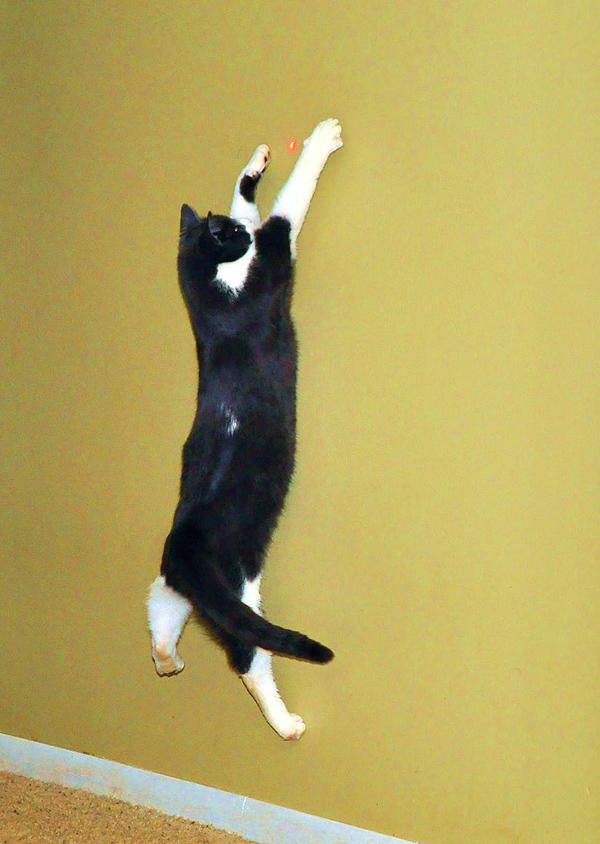
Buzz has a cat named Mnuchin, pronounced Munchkin, like the little characters from the Wizard of Oz, but spelled like Donald Trump's new Secretary of Treasury nominee, Steve Mnuchin.  

When Buzz is not crunching numbers on the Univac 3000, he's playing with Mnuchin, either using his red laser pointer or using some other bright shiny object to get Mnuchin to run around the room chasing the distraction.

While Buzz was getting Mnuchin to climb the walls, it reminded me how Trump has played the press and the American public with "bright shiny objects."  Whenever the press cycle has moved away from him, or more importantly, has moved to scrutinize one of his many questionable statements or positions, Trump gets out his laser pointer -- an off-the-wall tweet.

Conflicts of Interest

The perfect example is when the New York Times published a lengthy article about Trump's plethora of business interests throughout the world, many of which raise troubling conflicts of interest with being President.

The Times reported, among other things, as we all know, Trump has repeatedly said he is under audit from the Internal Revenue Service.   The IRS will be under direct supervision of the Trump administration.  The Trump International Hotel has a contract with the General Services Administration, whose operation again will be under the direct supervision of the Trump Administration.  Deutsche Bank is in negotiations with the Attorney General's office over mortgage abuses, which may result in a $14 billion penalty. Trump owes millions of dollars to Deutsche Bank.  The list goes on and on.

Richard Nixon on the law

Trump initially responded to the conflicts by taking a page from the book of Richard Nixon stating basically "when the President does it, that means it is not illegal."  He has since told us that he will hold a news conference sometime in mid-December with his children, where he will address the issue, but not before he tweeted about flag burning.

Flag Burning

"Nobody should be allowed to burn the American flag -- if they do there must be consequences -- perhaps loss of citizenship or a year in jail," Trump tweeted.

Despite the fact that the issue of criminal punishment for flag burning was settled by the United States Supreme Court in 1989 (Texas v. Johnson) and in the subsequent failed attempt to pass a Constitutional amendment, the question is still a third rail issue.  The Supreme Court decision, joined by conservatives the late Justice Antonin Scalia and Anthony Kennedy, held that flag burning was constitutionally protected free speech, and the proposed Constitutional Amendment didn't make it out of Congress.

For the next day or so, no one was talking about the conflicts of interest.  The buzz was over Trump's flag burning tweet.

In fact Buzz just received an email from the American Legion reviving the Constitutional Amendment prohibiting flag burning.  As of the time of posting, 83 percent supported an amendment in the American Legion survey.

So the bright shiny object worked again.  The conflict of interest story was pushed to the back burner.  This wasn't the first time we chased Trump's bright shiny object, and Buzz and I are afraid it won't be the last.

Thursday, November 17, 2016

The Trump Mandate

Courtesy of thekenyonthrill.com


The results of the 2016 Presidential Election came as a surprise to many of us, Buzz and I included, but does President-Elect Donald Trump have a mandate.  We asked Buzz to run some numbers to start.

Presidents who lost the popular vote, but won the Presidency

John Quincy Adams -- 1824

There is no record of the popular vote prior to the election of 1824, but what a year to start counting.  In the election of 1824, there was only one major political party --- the Democratic-Republican Party.  The Federalist Party of George Washington was by now on the ash heap of history.

There were no primaries and no conventions, so four Democratic-Republican candidates appeared on the ballot.  Here are the results:

Andrew Jackson               99 EV        153,544 votes
John Quincy Adams         84 EV         108,740 votes
William H. Crawford         41 EV           40,856 votes
Henry Clay                       37 EV          47,531 votes

Since none of the candidates received a majority of the electoral votes, the election of the President was thrown into the House of Representatives, of which Henry Clay was the Speaker.  The Twelfth Amendment provides that the House of Representatives will select the President among the top three candidates in electoral votes.  Each state gets one vote.

When the election was held in the House, Adams won 13 states, Jackson won 7, and Crawford won 4, thus Adams was elected.  In what would become known as the "corrupt bargain," Clay threw his support behind Adams.  In return, Clay was appointed to the stepping stone office of Secretary of State by Adams.  (Adams, James Monroe, James Madison, and Thomas Jefferson all held the position prior to being elected President.)

Rutherford B. Hayes -- 1876

In an election that ended Reconstruction in the South, Samuel J. Tilden, the Governor of New York received 4,288,546 votes or 50.9 percent. Ohio Governor and former Union Civil War General Rutherford B. Hayes received 4,034,311 or 47.9 percent.  Tilden thus became the only person ever to receive a majority of the popular vote and lose the Presidency.

The electoral count stood at 165 votes for Hayes and 184 votes for Tilden, one shy of a majority.  20 electoral votes were contested from four states.  Congress created a fifteen member electoral commission, which ultimately voted 8 to 7 to award all twenty contested electoral votes to Hayes.  Hayes was elected the 19th President.

Benjamin Harrison -- 1888

Twelve years later, Benjamin Harrison defeated incumbent President Gover Cleveland, 233 EV to 168 EV, but Cleveland won 5,534,488 votes (48.6 percent) to Harrison's 5,433,892 votes (47.8 percent.)  Cleveland would avenge his loss four years later, and thus become the only person to serve two non-consecutive terms as President.

George W. Bush --  2000

The election of 2000 came down to, in the words of the late Tim Russert, "Florida, Florida, Florida."  The election of the "hanging chad" was eventually decided by 537 votes in Florida when the United States Supreme Court, in a five to four decision, with no precedential effect, stopped a Florida recount.  George W. Bush defeated Vice President Al Gore 271 to 266 EVs.  (One elector from Washington, D.C. abstained.)

Gore received 50,999,897 popular votes (48.4 percent) to Bush's 50,456.002 popular votes (47.9 percent.)  Bush went on to be re-elected by a majority popular and EV in 2004 over Senator John Kerry of Massachusetts in 2004.

Donald Trump -- 2016

Donald Trump will now be the fifth person elected President without winning the popular vote.  Currently, he is losing the popular vote somewhere in the neighborhood of 61.5 million (46.7 percent) to Hillary Clinton's 62.8 million (47.7 percent.)  He currently leads the EV count 290 to 232, with Michigan's 16 electoral votes probably going to Trump.  There are still a few million votes yet to be counted, primarily in California.

So when all is said and done, it looks as though Trump will end up with a little over 46 percent of the vote.

Mandate or no?

Bill Clinton

Former Senator Bob Dole (the Senate Republican leader at the time said ,  "(h)e didn't get a majority," Mr. Dole said in an interview shortly after the 1992 Presidential election. "The country obviously didn't want Bush, but they weren't ready for Perot and they had plenty of doubts about Clinton. They want change. Well, we want to be responsible and deliver change, whatever that means, but we're skeptical, so we'll wait and see."

Clinton did receive a majority of the EVs, 370 to 168, but only received a purality of the popular vote.  Clinton defeated incumbent George H. W. Bush 43 percent to 37 percent in a three way race.  Texas billionaire H. Ross Perot got 19 percent of the vote.  

Clinton came to office as a new centrist Democrat, and attempted some liberal policies (Hillarycare, among them,) but got quite a wake up call in 1994, when the GOP picked up 54 seats in the House and 8 seats in the Senate, to gain a 35 seat and a 4 seat majority in the House and Senate, respectively.  Clinton suffered through a GOP Congressional majority for the rest of his Presidency.

Clinton pivoted, and much to the dismay of many liberals, governed from a center left position.  He changed the welfare system as we knew it, signed the Defense of Marriage Act, and also signed the 1994 crime bill, among other not so liberal legislation.  Clinton realized that the "mandate" he received in 1992 wasn't that much of a mandate.

George W. Bush

George W. Bush began to reach across the aisle after being sworn in as the 43rd President in 2001, No Child Left Behind education reform among the bi-partisan measures he steered through Congress.  Much of that changed after 9/11, when the country forgot about the 2000 election and turned their eyes to national security.  

In 2005, after his defeat of Kerry, Bush was unable to use his "political capital" to radically reform Social Security.  So even when you win a majority of the popular vote, moving the Washington establishment is not an easy task.

Trump's mandate

So can Trump turn a 46 percent popular vote pluraity, albeit a clear electoral majority, into a mandate?  Considering, the election of 2016 is only nine days away, and he has not even named one cabinet member, it is too early to tell.

Republicans in Congress have waited eight long years to reverse the Obama revolution, and remember it is much easy to be the loyal opposition than it is to govern.  It is also important to remember that the GOP is not a singular force.  Where the GOP had a common enemy in the Democrats and Obama, they may not be all on the same page with Obama gone and the Democrats in the minority in both Houses of Congress.

We have already begun to see some cracks in the wall, no pun intended.  Republicans, Trump included, have been chanting "repeal and replace" the Affordable Care Act  (Obamacare) since its adoption in 2010, but the "replace" component is anybody's guess.  Trump said multiple times during the campaign that he would "repeal and replace (Obamacare) with something terrific."

Buzz and I are all for "terrific," but your opinion of "terrific" and our opinion of "terrific" may be quite different.  We think "terrific" should include free deep muscle massages from a talented masseuse with every colonoscopy, but including that in a replacement law might be problematic.

Obamacare has some very popular provisions.  People like that fact that insurance companies can't throw you into an expensive high-risk pool for having a pre-existing condition or deny coverage all together, and that children can remain on their parents' insurance policy until they're 26.  They are also very happy with the subsidies which make health insurance much more affordable.

Trump has never really specified what really "terrific" means, although he has said that he supports "single payer" in the past.  As far as the Republicans in Congress, they run the gamut from repealing and replacing it with nothing to some type of modifications that involve unspecified "free market" solutions.  When there's a pig in the parlor, burning down the house to rid yourself of the pig is rarely the best solution.

We also see problems pursuing policies that would include building a "wall" and making "Mexico pay for it," appointing a special prosecutor to "lock up" Hillary Clinton, banning all Muslims from entering the United States, and "bomb and take oil from ISIS."  They may just be campaign hyperbole, but this subtlety may be lost on a lot of people who voted for Trump.

A good portion of the American electorate has voted for change, but there are a million different definitions of what that change encompasses.  

One of the major dilemmas of running a campaign that is rich on platitudes and short on substance is that platitudes are hard to convert into actual policy and legislation.  Make America Great Again may be a great slogan to put on a hat, but it's difficult to translate that into legislation, especially when it means something different to almost everyone who hears it.

Buzz and I will wait and see.  We will withhold judgment for the moment, but we will also be waiting for our free massages.